Architecture
radical_simplicity
The principle
When there are two options, opt for the simpler one, until complexity necessitates the advanced option.
Premature complexity is the enemy. Systems, teams, and processes should be minimal, durable, and driven by actual business needs, not by what's trending on Hacker News. And not just because the agent can.
This applies to greenfield projects and refactoring existing systems alike. Domain-Driven Design reveals the right boundaries and translates them into architecture, implemented hands-on, together with the teams.
Coffee doesn't have to be complicated.
Each of the four makes a good coffee. Every step to the right is legitimate when the problem demands it. Most of the time it doesn't, yet. With agents, even less often: the scale shifts left.
Radical Simplicity spans three pillars.
Team structure
Team Structure.
Small Smaller Domain Teams with Agents.
Vertical teams organized around business domains, not horizontal backend/frontend splits. The agent is full stack. The split lost its last excuse. Small, autonomous, and aligned with the bounded contexts identified through DDD. Each team owns its domain end-to-end. One or two people with agents can.
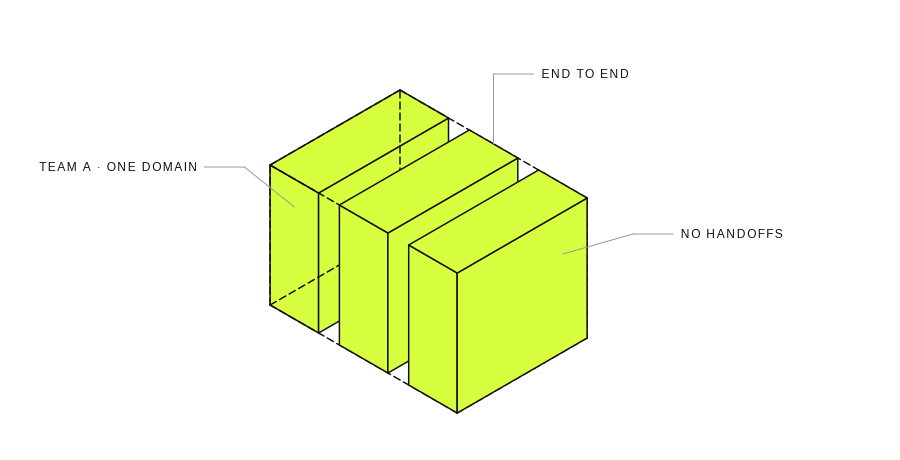
Fewer handoffs
This structure reduces handoffs, speeds up decisions, and gives teams real ownership over the value they deliver. The handoffs that remain go to agents: written down, or they fail.
Boundaries from the domain
The teams follow the boundaries of the domain, which DDD helps to find. Not the org chart, and not the tech layers. A domain boundary is also the agent’s context boundary.
Development process
Development Process.
Lean & Agile. Documented.
Lightweight processes like Kanban over heavy ceremony. A feature takes an afternoon. A sprint takes two weeks. The goal is flow and fast feedback, not process for process's sake. The fastest feedback is the agent’s own loop.
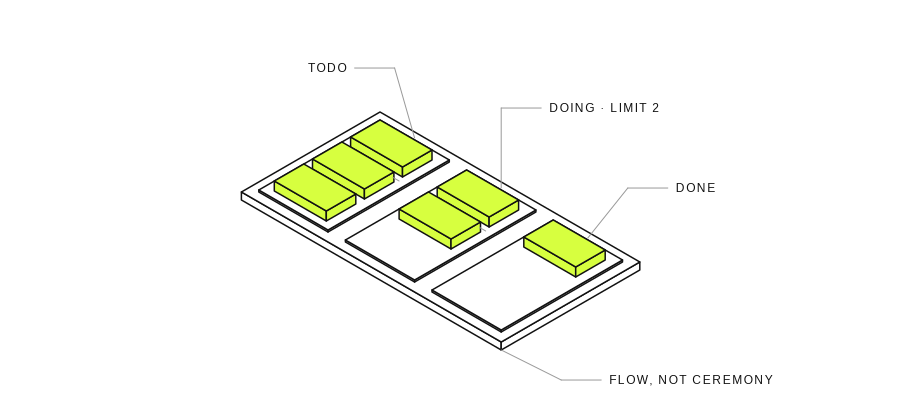
Low overhead
Keep the overhead low so teams can focus on delivering value. Low for the humans. Explicit for the agent.
Barely noticeable
The best process is the one you barely notice only notice in the workflow file.
Tech stack
Tech Stack.
Minimal & Durable. Trained.
Start with the simplest thing that works. And that the agent can check: tests, a local run. Add complexity only when the problem demands it, not before. Writing code got cheap. Running and understanding it didn’t.
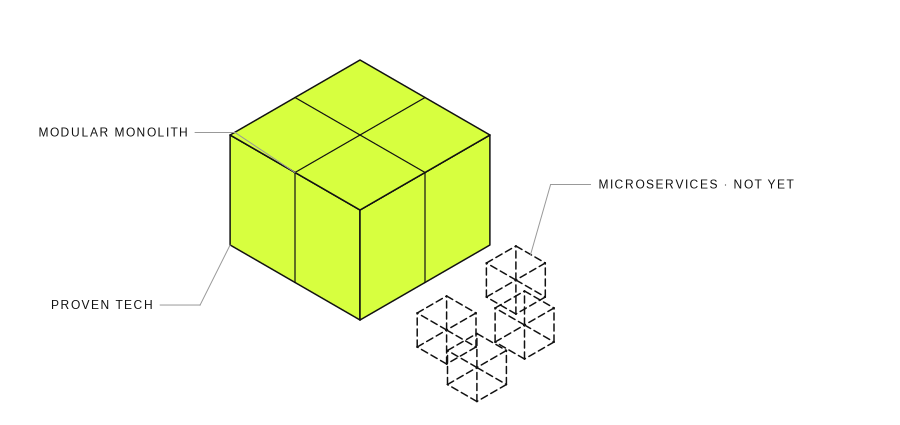
Modular monoliths over premature microservices
Scale the architecture when the load requires it, not because a blog post said so. Or because the agent offered a service. One deployable is what it can see whole.
Server-side rendering over SPAs
Unless you're building something that genuinely needs it. Less surface, less for the agent to break.
Choose boring, proven technology
Durable over fashionable: the stack should still make sense in a few years. Boring tech is what the models have seen most of.
In summary.
All three belong together.
This is not just about code or architecture diagrams. It's a holistic approach: how teams are structured, how they work, and what they build with. All three need to be aligned for software to ship sustainably. And the agents work inside all three.
Further reading
More detail on this, specifically for web applications:
Radically Simple Web ArchitectureBeyond the web
The philosophy applies equally to pure backend systems and services.
Let's talk.
Just send me an email and tell me what you're building and where it hurts.